
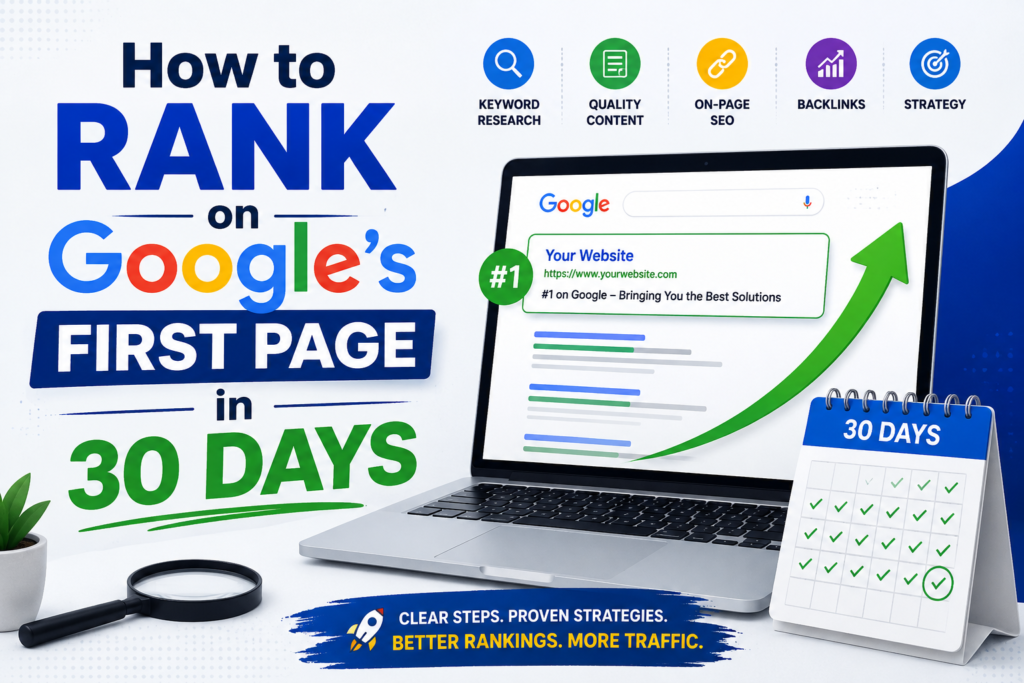
If you have a website or blog, you want it to show on Google’s first page. But many people don’t know how to do it. The good thing is, if you follow the right steps, you can learn how to rank on Google fast and see results in 30 days.
In this blog, you will learn simple steps that actually work.
1. Choose the Right Keyword
First, you need to pick the right keyword. If the keyword is too hard, it will take a lot of time to rank.
Try to choose:
- Easy keywords
- Longer keywords (more specific)
- Keywords people are really searching for
This is the first step in learning how to rank on Google fast, so take your time here.
2. Write Helpful Content
Your content should help people. Google shows content that gives clear answers.
Make sure your content:
- Solves a problem
- Is easy to read
- Uses headings (H1, H2, H3)
- Has enough length (around 800–1000 words)
Use your keyword how to rank on Google fast in the title, first paragraph, and a few times in the blog. But don’t repeat it too much.
3. Do Basic SEO on Your Page
This helps Google understand your page better.
Check these things:
- Add keyword in the title
- Write a short description (meta description)
- Keep the URL short
- Add names to your images (alt text)
- Link to other pages on your website
These small steps of doing basic SEO help a lot in how to rank on Google fast.
4. Make Your Website Fast
If your website is slow, people will leave quickly. Google also doesn’t like slow websites.
To make it faster:
- Use small image sizes
- Choose good hosting
- Remove extra plugins
A fast website helps you in how to rank on Google fast.
5. Make It Work Well on Mobile
Most people use phones to search. Your website should look good and work well on mobile.
Check:
- Easy to use on phone
- Loads quickly
- Text is easy to read
This is very important for better ranking.
6. Get Links from Other Websites
When other websites link to you, Google sees your site as trusted.
You can get links by:
- Writing blogs for other websites
- Sharing your blog on social media
- Creating useful content
Even a few good links can help you understand how to rank on Google fast.
7. Link Your Own Pages
Link your blog to other pages on your website.
This helps:
- Users stay longer
- Google understand your website
Always connect related pages.
8. Understand What People Want
You should know what people are looking for.
Some people want:
- Information
- A website
- A product
Make your content match their need. This is an important part of how to rank on Google fast.
9. Be Regular
You won’t see results in one day. Keep working on your website.
Do this:
- Post new blogs
- Update old blogs
- Keep improving
If you stay regular, you will see better results.
10. Check Your Progress
Use tools like Google Analytics and Search Console.
Look at:
- Your ranking
- Website visitors
- Clicks
This will help you know what is working.
Final Words
Getting on Google’s first page in 30 days is possible if you follow the right steps. Focus on simple things like good content, basic SEO, and user experience.
If you follow these steps, you will learn how to rank on Google fast and grow your website step by step.
Start today, stay regular, and you will see results. Also, Follow us on Instagram and Facebook for more updates.
Frequently Asked Questions (FAQs)
How to rank on Google fast for a new website?
To rank a new website fast, choose easy keywords, write helpful content, and do basic SEO. Also, make sure your website loads fast and works well on mobile.
Can I really rank on Google in 30 days?
Yes, you can rank in 30 days if you target low competition keywords and follow the right steps. But for high competition keywords, it may take more time.
How many times should I use my keyword?
You should use your keyword naturally around 5–7 times in your blog. Don’t repeat it too much, or it may hurt your ranking.
Do backlinks help in ranking fast?
Yes, backlinks help a lot. They tell Google that your website is trusted. Even a few quality backlinks can improve your ranking.
Why is my website not ranking on Google?
Your website may not rank because of high competition, weak content, slow speed, or lack of SEO. Fixing these can improve your ranking.


