
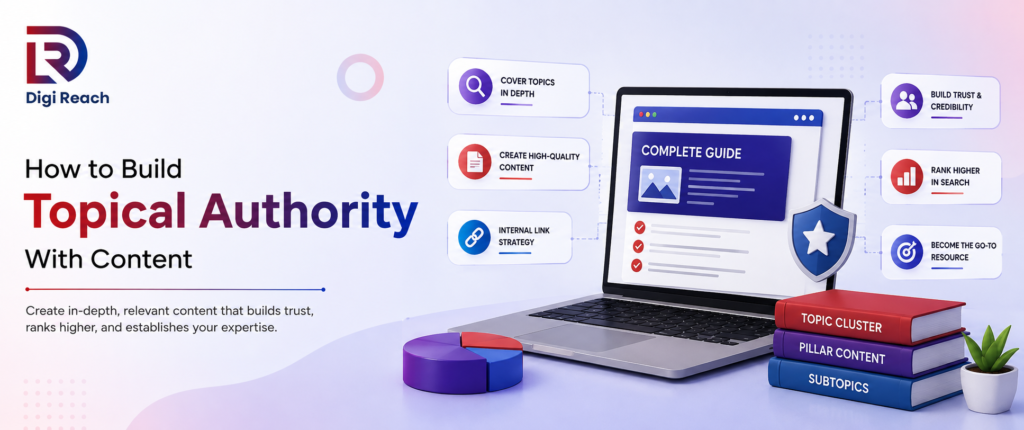
What Is Topical Authority?
Topical authority means showing Google and your readers that your website has strong and trustworthy knowledge about a specific topic.
Instead of writing random blogs for different keywords, create a group of useful articles that cover the same topic from different angles.
For example, if your business offers digital marketing services, don’t just write about SEO. You can also create content about keyword research, technical SEO, local SEO, link building, content optimization, Google Search Console, SEO analytics, and other related topics.
This helps create a strong content ecosystem around your main subject.
Why Is Topical Authority Important for SEO?
Modern SEO is not just about adding keywords to a page. Search engines also look at the meaning, context, and connection between different topics.
Building topical authority can help your website:
- Improve its visibility for relevant searches
- Target multiple related keywords
- Build trust with potential customers
- Create stronger internal linking opportunities
- Support higher rankings across related topics
- Attract more qualified organic traffic
- Improve the overall user experience
Topical authority does not mean publishing hundreds of low-quality articles. It is more important to create useful, relevant, and well-connected content than to publish a large amount of content.
7 Steps to Build Topical Authority With Content
1. Choose a Clear Core Topic
Start with a subject that is closely connected to your products or services.
For example, a digital marketing agency could choose digital marketing as its broad topic.
From there, identify important subtopics such as:
- SEO
- Local SEO
- Google Ads
- Social media marketing
- Content marketing
- Email marketing
- Conversion rate optimization
- Marketing automation
- AI in marketing
A focused topic helps search engines understand what your website is primarily about.
2. Create Topic Clusters
One of the most effective ways to build topical authority is through topic clusters.
A topic cluster usually contains:
Pillar Page → Cluster Content → Internal Links
Your pillar page covers the main topic, while supporting articles answer specific questions related to that topic.
For example:
Pillar Topic: SEO
Supporting topics could include:
- What Is SEO?
- How Does Keyword Research Work?
- What Is Technical SEO?
- How to Improve Website Speed
- What Is Local SEO?
- How to Build Quality Backlinks
- How to Optimize Blog Content
- What Is Google Search Console?
Each supporting article should connect naturally to the main SEO page and other relevant content.
3. Research Your Audience’s Search Intent
Creating content only around keywords is not enough. You also need to understand what people want to find when they search.
Search intent generally falls into categories such as:
- Informational: The user wants to learn something.
- Navigational: The user is looking for a specific website or page.
- Commercial: The user is researching options before making a decision.
- Transactional: The user is ready to take action or make a purchase.
For example, someone searching “what is local SEO” is likely looking for information. But someone searching “best digital marketing agency in Patiala” may be ready to choose a service and make a purchase.
Create content that matches the intent behind the search.
4. Cover Topics in Depth
Topical authority requires comprehensive coverage.
If you are targeting a major topic, think about the questions your audience may have before, during, and after learning about it.
For example, a website targeting Google Ads could cover:
- What Google Ads are
- How Google Ads work
- Keyword research for Google Ads
- Google Ads campaign types
- Ad copywriting
- Landing page optimization
- Cost per click
- Conversion tracking
- Common Google Ads mistakes
- Ways to reduce cost per lead
This creates a deeper resource instead of relying on one general article.
5. Build a Strong Internal Linking Structure
Internal links connect related pages on your website.
They help users discover more useful information while also helping search engines understand the relationship between your pages.
For example, an article about local SEO could naturally link to content about:
- Google Business Profile optimization
- Local keyword research
- Local citations
- Online reviews
- Google Maps rankings
Use descriptive anchor text and link only when the destination provides additional value.
6. Update and Improve Existing Content
Topical authority is an ongoing process.
Some information becomes outdated, search intent changes, and competitors publish better resources. Therefore, regularly review your existing content.
During a content update, check:
- Is the information still accurate?
- Are the target keywords still relevant?
- Does the article fully answer the searcher’s question?
- Can new sections improve the content?
- Are internal links relevant?
- Are statistics and examples current?
- Are there outdated claims or broken links?
Updating valuable content can be more effective than constantly publishing new articles.
7. Focus on Quality and Original Value
Publishing content just to increase your website’s page count can hurt your overall content strategy.
Instead, every article should have a clear purpose.
Good SEO content should:
- Answer real customer questions
- Provide practical information
- Demonstrate expertise
- Use clear and simple language
- Include relevant examples
- Avoid unnecessary repetition
- Connect naturally with related content
- Provide information that is genuinely useful
The goal is not to write the longest article. The goal is to create the most useful resource for the intended search.
Topical Authority vs Keyword Stuffing
Keyword stuffing focuses heavily on repeating exact keywords throughout a page.
Topical authority takes a broader approach.
For example, instead of repeatedly using the keyword “digital marketing strategy”, you can naturally discuss:
- Audience research
- Competitor analysis
- SEO
- Paid advertising
- Social media
- Content marketing
- Conversion optimization
- Analytics
- Customer journeys
This gives the content greater context while keeping it natural for readers.
How to Create a Topical Authority Content Strategy
A simple process can help you build your strategy:
Step 1: Choose your main business topic.
Step 2: Identify major subtopics.
Step 3: Research related questions and search intent.
Step 4: Create a pillar page.
Step 5: Develop supporting cluster content.
Step 6: Connect relevant pages with internal links.
Step 7: Monitor performance and update content regularly.
You can also create a content calendar that balances beginner-level, advanced, informational, commercial, and conversion-focused content.
Common Topical Authority Mistakes to Avoid
Publishing Unrelated Topics
Writing about completely unrelated subjects can make your website‘s content structure less focused.
Creating Thin Content
Short content is not automatically bad. However, pages that fail to provide useful answers may have limited value.
Ignoring Search Intent
A well-optimized article can still perform poorly if it does not satisfy what users actually want.
Overusing Keywords
Use keywords naturally. Search engines understand related concepts, so repeating the same phrase excessively is unnecessary.
Forgetting Internal Links
Even excellent content can become difficult to discover when pages are not properly connected.
Never Updating Old Content
A strong content strategy includes both creating new content and improving existing content.
How DigiReach Can Help Build Your Topical Authority
Building topical authority requires more than publishing blogs regularly. It requires a structured SEO and content strategy.
At DigiReach, we help businesses develop content strategies designed around their audience, services, search intent, and business goals. From keyword research and topic clusters to SEO content, internal linking, and content optimization, every part of the strategy works together.
Whether your goal is to increase organic traffic, improve Google rankings, generate qualified leads, or strengthen your online presence, a well-planned topical authority strategy can help you build sustainable SEO growth.
Conclusion
Topical authority is built through consistency, relevance, expertise, and useful content.
Instead of creating isolated blog posts, build a connected content ecosystem that answers your audience’s questions at different stages of their search journey.
Start with one core topic, create meaningful topic clusters, strengthen internal links, match search intent, and continuously improve your content.
Over time, this structured approach can help your website become a stronger and more trusted resource in its industry.
Follow up Instagram and Facebook for more information.


