
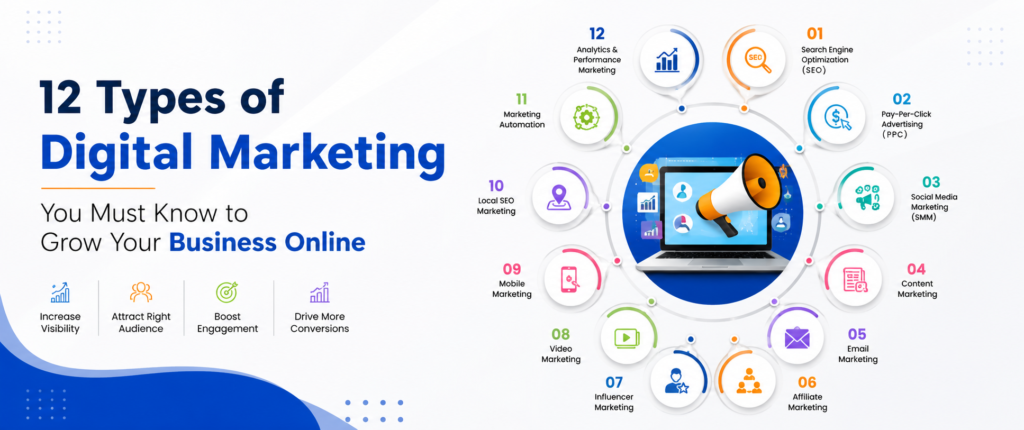
12 Types of Digital Marketing You Must Know to Grow Your Business Online
Digital marketing has become the backbone of modern business growth. Whether you’re a startup, local business, or started brand, having a strong online existence is no longer optional—it’s important. Today, consumers search for products, compare services, read reviews, and make buying choices online before contacting a business.
A well-planned digital marketing plans helps you attract the right audience, build brand knowledge, generate qualified leads, and increase sales. However, digital marketing isn’t a single technique. Instead, it combines multiple channels and plans that work together to deliver can be measure business results.
Therefore, understanding the different types of digital marketing allows you to choose the most effective plans based on your business goals, target audience, and budget. As a result, you can give your marketing resources more quickly, reach the right customers through the right channels, and achieve better returns on your investment. Ultimately, selecting the right combination of digital marketing techniques helps drive long term business growth and long-term success.
In this comprehensive DigiReach guide, you’ll discover the 12 most effective types of digital marketing, how each works, their benefits, and when to use them for maximum business growth.
What Is Digital Marketing?
Digital marketing is the practice of promoting products or services using online channels such as search engines, websites, social media platforms, email, mobile apps, and paid advertisements.
Unlike traditional marketing, digital marketing enables businesses to:
- Reach highly targeted audiences
- Measure campaign performance in real time
- Generate quality leads
- Increase website traffic
- Improve customer engagement
- Boost online sales
- Optimize marketing campaigns using data
Because nearly every customer journey begins online, digital marketing has become one of the most powerful ways to grow any business.
Why Is Digital Marketing Important?
Today, consumers spend hours every day searching on Google, browsing social media, watching videos, and reading online reviews before making purchasing decisions. Therefore, if your business isn’t visible online, you’re likely missing valuable opportunities to connect with potential customers. Moreover, a strong digital presence helps build trust, increase brand awareness, and attract qualified leads. As a result, businesses that invest in digital marketing are better positione to stay competitive, engage their target audience, and drive long-term growth.
Digital marketing helps businesses:
- Increase online visibility
- Build brand credibility
- Reach local and global audiences
- Generate qualified leads
- Improve customer relationships
- Drive more website traffic
- Increase sales and revenue
- Measure ROI accurately
- Stay ahead of competitors
Most importantly, digital marketing allows businesses of all sizes to compete effectively without spending massive advertising budgets. In fact, even small businesses and startups can reach their target audience, build brand awareness, and generate qualified leads through cost-effective online marketing strategies. Furthermore, by leveraging data-driven insights and measurable campaigns, businesses can continuously optimize their marketing efforts, maximize their return on investment (ROI), and achieve long-term growth.
1. Search Engine Optimization (SEO)
Search Engine Optimization (SEO) is the process of improving your website so it ranks higher on Google and other search engines for relevant keywords.
When people search for products or services your business offers, SEO helps your website appear in front of them organically—without paying for every click.
Types of SEO
On-Page SEO
Optimizing website content, headings, images, URLs, and keywords.
Off-Page SEO
Building backlinks and improving your website’s authority across the web.
Technical SEO
Improving website speed, mobile responsiveness, indexing, security, and crawlability.
Local SEO
Optimizing your business for local searches and Google Business Profile.
Benefits of SEO
- Free organic traffic
- Higher Google rankings
- Better user experience
- Increased website authority
- Long-term business growth
- Higher conversion potential
SEO is one of the highest ROI digital marketing strategies because it continues generating traffic over time.
2. Pay-Per-Click (PPC) Advertising
PPC advertising allows businesses to display ads on search engines and social media platforms while paying only when someone clicks the ad.
Popular PPC platforms include:
- Google Ads
- Microsoft Ads
- Facebook Ads
- Instagram Ads
- LinkedIn Ads
- YouTube Ads
Benefits
- Instant website traffic
- Highly targeted audience
- Flexible advertising budget
- Fast lead generation
- Measurable campaign performance
- Quick return on investment
PPC is ideal for businesses seeking immediate visibility while building long-term SEO efforts.
3. Content Marketing
Content marketing focuses on creating valuable, informative, and engaging content that attracts, educates, and converts potential customers. Instead of directly promoting products or services, it provides useful information that addresses your audience’s needs, answers their questions, and solves their problems. As a result, businesses build trust, establish industry authority, improve search engine rankings, and nurture potential customers throughout their buying journey.
Common content formats include:
- Blog posts
- Articles
- Videos
- Infographics
- E-books
- Case studies
- Checklists
- Podcasts
- Whitepapers
- Guides
Benefits
- Builds customer trust
- Improves SEO rankings
- Generates qualified leads
- Educates potential customers
- Establishes industry authority
- Supports every marketing channel
Great content answers customer questions while positioning your business as an expert.
4. Social Media Marketing
Social media marketing uses platforms like Facebook, Instagram, LinkedIn, TikTok, and X (formerly Twitter) to connect with your target audience, increase engagement, and promote products or services. By consistently sharing valuable content, interacting with followers, and running targeted advertising campaigns, businesses can strengthen brand awareness and build lasting customer relationships. Furthermore, social media enables brands to receive real-time feedback, drive website traffic, generate qualified leads, and boost conversions. As a result, it has become an essential digital marketing strategy for businesses looking to grow their online presence and stay competitive.
Popular platforms include:
- X (Twitter)
- TikTok
- YouTube
Benefits
- Increased brand awareness
- Better customer engagement
- Website traffic growth
- Community building
- Lead generation
- Improved customer loyalty
Consistent posting combined with valuable, relevant content helps businesses build long-term relationships with customers. Additionally, regularly engaging with your audience through comments, messages, and interactive posts strengthens trust and encourages customer loyalty. As a result, businesses can increase brand recognition, improve customer retention, and create a loyal community that supports long-term business growth.
5. Email Marketing
Email marketing remains one of the most cost-effective digital marketing channels, delivering one of the highest returns on investment (ROI). By sending personalized and relevant emails to subscribers, businesses can nurture leads, strengthen customer relationships, and encourage repeat purchases. Furthermore, email marketing allows brands to share promotions, product updates, newsletters, and valuable content directly with their audience. As a result, it helps increase customer engagement, improve retention, and drive long-term business growth.
Businesses use email campaigns for:
- Newsletters
- Promotions
- Product launches
- Educational content
- Welcome emails
- Cart abandonment reminders
- Customer retention
Benefits
- Personalized communication
- Higher customer retention
- Increased repeat sales
- Better customer relationships
- Excellent ROI
- Marketing automation opportunities
Permission-based email marketing builds trust while nurturing leads into loyal customers.
6. Affiliate Marketing
Affiliate marketing allows businesses to partner with publishers, bloggers, influencers, and websites that promote their products or services in exchange for a commission on successful sales or leads. Instead of relying solely on traditional advertising, businesses can expand their reach through trusted partners who recommend their offerings to relevant audiences. Furthermore, this performance-base marketing model minimizes financial risk because commissions are paid only when desire results are achieve. As a result, affiliate marketing helps increase brand visibility, drive qualified traffic, and boost sales while maintaining a cost-effective marketing budget.
Affiliates earn when they generate:
- Sales
- Leads
- Sign-ups
- App downloads
Benefits
- Performance-based marketing
- Low financial risk
- Increased brand exposure
- Expanded customer reach
- Higher online sales
Affiliate marketing is especially popular among eCommerce brands because it enables them to expand their reach and increase sales through trusted partners. Additionally, businesses only pay commissions when affiliates generate successful sales or qualified leads, making it a cost-effective and performance-driven marketing strategy. As a result, affiliate marketing helps improve brand visibility, attract targeted customers, and support sustainable business growth.
7. Influencer Marketing
Influencer marketing involves collaborating with content creators who have built loyal and engaged audiences across social media platforms. These influencers promote your products or services through authentic recommendations, reviews, tutorials, videos, and sponsored content, helping brands connect with potential customers more naturally. Furthermore, partnering with trusted influencers enhances brand credibility, expands audience reach, and increases customer engagement. As a result, influencer marketing can drive more website traffic, generate qualified leads, and improve conversions, making it an effective strategy for businesses looking to grow their online presence.
Influencers promote products through:
- Reviews
- Tutorials
- Sponsored posts
- Instagram Reels
- YouTube videos
- Live sessions
- Stories
Benefits
- Builds trust quickly
- Increases brand awareness
- Improves engagement
- Generates social proof
- Drives conversions
Micro-influencers often deliver higher engagement rates than celebrity influencers because they have more niche, loyal, and highly engaged audiences. Additionally, they are generally more affordable, making influencer marketing accessible for small and medium-sized businesses. As a result, partnering with micro-influencers can increase brand awareness, build customer trust, and generate better returns on marketing investment while keeping campaign costs under control.
8. Video Marketing
Video marketing has become one of the fastest-growing digital marketing strategies because video content captures attention, increases engagement, and communicates information quickly. Whether through product demonstrations, tutorials, customer testimonials, or brand stories, videos help businesses connect with their audience in a more engaging and memorable way. Furthermore, video content performs well across websites, social media platforms, and search engines, helping improve visibility and reach. As a result, businesses can increase brand awareness, build customer trust, drive website traffic, and boost conversion rates.
Businesses create videos for:
- Product demonstrations
- Tutorials
- Brand storytelling
- Customer testimonials
- Educational videos
- Behind-the-scenes content
- FAQs
- Webinars
Popular platforms include:
- YouTube
- Instagram Reels
- TikTok
Benefits
- Higher engagement
- Better customer understanding
- Increased social sharing
- Improved SEO
- Higher conversion rates
Videos simplify complex information, making it easier for audiences to understand products, services, or concepts. Additionally, engaging visuals and storytelling help capture attention and keep viewers interested for longer periods. As a result, businesses can improve audience retention, increase social media engagement, strengthen brand awareness, and encourage more conversions through effective video marketing.
9. Mobile Marketing
Mobile marketing targets users on smartphones and tablets, where the majority of internet browsing, shopping, and online interactions now take place. By delivering personalized messages through SMS, mobile apps, push notifications, and mobile-friendly websites, businesses can connect with customers anytime and anywhere. Furthermore, a mobile-first marketing approach enhances user experience, increases engagement, and improves conversion rates. As a result, mobile marketing has become an essential strategy for reaching today’s on-the-go consumers and driving sustainable business growth.
Strategies include:
- SMS marketing
- Mobile apps
- Push notifications
- Mobile-friendly websites
- In-app advertising
- QR code campaigns
Benefits
- Direct customer communication
- Better user experience
- Higher engagement
- Increased conversions
- Wider audience reach
Optimizing your website for mobile devices is essential because Google primarily uses the mobile version of a website for indexing and ranking. Additionally, a fast, responsive, and mobile-friendly website provides a better user experience, reduces bounce rates, and keeps visitors engaged. As a result, businesses can improve their search engine rankings, attract more organic traffic, increase conversions, and stay competitive in today’s mobile-first digital landscape.
10. Local SEO
Local SEO helps businesses appear in search results when nearby customers are looking for products or services in their area. By optimizing your website and business listings for location-based searches, you can increase your visibility among local audiences who are ready to make a purchase or book a service. Furthermore, Local SEO improves your presence on Google Search and Google Maps, making it easier for potential customers to find, contact, and visit your business. As a result, it drives more local traffic, generates qualified leads, and supports long-term business growth.
Examples include:
- Dentist near me
- Coffee shop nearby
- Best digital marketing agency in Chandigarh
Local SEO includes:
- Google Business Profile optimization
- Customer reviews
- Local citations
- Location pages
- Local keyword optimization
Benefits
- Increased local visibility
- More phone calls
- Better Google Maps rankings
- Higher foot traffic
- More local leads
Local SEO is especially valuable for healthcare providers, restaurants, retailers, and service-based businesses that rely on attracting customers from specific geographic areas. Additionally, optimizing for local search helps these businesses appear in “near me” searches and Google Maps results, increasing their visibility among nearby customers. As a result, businesses can generate more phone calls, website visits, store traffic, appointment bookings, and qualified local leads, ultimately driving long-term growth and improving their competitive advantage.
11. Marketing Automation
Marketing automation uses software to streamline and automate repetitive marketing tasks while enhancing the overall customer experience. By automating processes such as email campaigns, lead nurturing, customer segmentation, follow-up messages, and CRM workflows, businesses can save time and improve efficiency. Furthermore, marketing automation delivers personalized communication at every stage of the customer journey, helping businesses engage prospects more effectively. As a result, it increases productivity, strengthens customer relationships, improves lead conversions, and supports scalable business growth.
Automation includes:
- Email sequences
- Lead nurturing
- CRM integration
- Customer segmentation
- Workflow automation
- Automated follow-ups
Benefits
- Saves time
- Improves efficiency
- Better personalization
- Higher lead conversions
- Consistent communication
Marketing automation allows businesses to scale their marketing efforts without significantly increasing manual work. Additionally, it streamlines repetitive tasks, maintains consistent communication, and delivers personalized experiences to customers at the right time. As a result, businesses can improve operational efficiency, nurture more leads, increase conversion rates, and focus on strategic initiatives that drive long-term growth.
12. Conversion Rate Optimization (CRO)
Driving website traffic is only the first step in achieving online success. However, attracting visitors alone isn’t enough if they don’t take meaningful actions. Conversion Rate Optimization (CRO) focuses on turning website visitors into customers by improving the overall user experience and encouraging desired actions, such as making a purchase, filling out a contact form, subscribing to a newsletter, or requesting a quote. Furthermore, CRO helps businesses maximize the value of their existing website traffic without increasing advertising costs. As a result, it improves conversion rates, boosts revenue, and delivers a higher return on investment (ROI).
CRO improves:
- Landing pages
- Website design
- Forms
- Calls-to-action
- Page speed
- User experience
Benefits
- Higher conversion rates
- Better ROI
- Lower customer acquisition cost
- Increased revenue
- Improved customer experience
Even small improvements in conversion rates can significantly increase overall business profitability. Additionally, optimizing landing pages, call-to-action buttons, website design, and user experience helps convert more visitors into paying customers without increasing traffic. As a result, businesses can maximize their existing marketing efforts, reduce customer acquisition costs, improve return on investment (ROI), and achieve sustainable long-term growth.
Why an Integrated Digital Marketing Strategy Matters
The most successful businesses don’t rely on a single digital marketing channel. Instead, they combine multiple strategies that work together to achieve their marketing goals. For example, SEO attracts organic traffic, content marketing educates and engages potential customers, social media builds brand awareness, email marketing nurtures leads, and PPC delivers immediate visibility. Furthermore, integrating these digital marketing strategies creates a seamless customer journey across multiple touchpoints. As a result, businesses can increase brand visibility, generate more qualified leads, improve customer engagement, and achieve sustainable long-term growth.
For example:
- SEO drives long-term organic traffic.
- Content marketing educates and builds trust.
- Social media increases engagement and brand awareness.
- PPC generates immediate traffic.
- Email marketing nurtures leads into customers.
- Marketing automation improves efficiency.
- CRO maximizes conversions.
When these digital marketing channels work together, businesses create a stronger and more consistent online presence across multiple platforms. Furthermore, an integrated marketing strategy ensures that every channel supports the customer journey—from building brand awareness and attracting visitors to generating leads and increasing conversions. As a result, businesses can improve customer engagement, maximize their marketing return on investment (ROI), strengthen brand loyalty, and achieve sustainable long-term growth in an increasingly competitive digital landscape.
How DigiReach Helps Businesses Grow Online
At DigiReach, we understand that every business has unique goals, challenges, and target audiences. That’s why we develop customized digital marketing strategies designed to deliver measurable, long-term results.
Our digital marketing services include:
- Search Engine Optimization (SEO)
- Google Ads (PPC)
- Social Media Marketing
- Content Marketing
- Email Marketing
- Website Design & Development
- Local SEO
- Conversion Rate Optimization (CRO)
- Marketing Strategy & Consulting
- Performance Analytics & Reporting
Whether you’re launching a startup or scaling an established business, DigiReach provides customized, data-driven digital marketing solutions designed to help you achieve your unique business goals. From increasing online visibility and attracting qualified leads to improving conversions and maximizing revenue, our expert team develops strategies tailored to your industry and target audience. Furthermore, we continuously monitor and optimize campaign performance to deliver measurable results and long-term success. As a result, your business can build a stronger online presence, stay ahead of the competition, and achieve sustainable growth in today’s digital marketplace.
Conclusion
Digital marketing offers countless opportunities for businesses to grow online, reach new customers, and strengthen their brand presence. However, long-term success comes from choosing the right combination of strategies rather than relying on a single marketing channel. By integrating SEO, content marketing, social media, email marketing, PPC advertising, and other digital marketing techniques, businesses can create a cohesive and effective online marketing strategy. Furthermore, each channel supports different stages of the customer journey, helping attract, engage, nurture, and convert potential customers. As a result, businesses can maximize their marketing efforts, achieve a higher return on investment (ROI), and drive sustainable long-term growth.
SEO builds long-term online visibility by improving search engine rankings, while PPC delivers immediate website traffic through targeted paid advertising. At the same time, content marketing establishes brand authority by providing valuable information, social media marketing strengthens customer relationships through consistent engagement, email marketing nurtures leads with personalized communication, and Conversion Rate Optimization (CRO) turns website visitors into paying customers. Together, these digital marketing strategies create a seamless customer journey that attracts, engages, and converts potential customers. As a result, businesses can increase brand awareness, generate qualified leads, maximize return on investment (ROI), and achieve sustainable long-term growth.
By understanding and implementing these 12 types of digital marketing, businesses can build a strong online presence, attract the right audience, generate qualified leads, improve conversion rates, and increase revenue. Furthermore, combining multiple digital marketing strategies allows businesses to create a seamless customer journey, strengthen brand credibility, and stay ahead of the competition. As a result, they can achieve sustainable business growth, maximize their return on investment (ROI), and adapt successfully to the ever-evolving digital landscape.
At DigiReach, we help businesses unlock their full online potential with customized digital marketing strategies tailored to their unique goals, industry, and target audience.
Whether you’re looking to improve search engine rankings, generate more qualified leads, increase website traffic, strengthen your brand presence, or boost sales, our experienced team develops data-driven solutions that deliver measurable results. Furthermore, we continuously monitor, analyze, and optimize every campaign to maximize performance and return on investment (ROI). As a result, your business can achieve sustainable growth, stay ahead of the competition, and succeed in today’s ever-evolving digital marketplace.
Follow DigiReach on Instagram and Facebook for the latest digital marketing tips, trends, and business growth strategies.
Frequently Asked Questions (FAQs)
1. What are the 12 types of digital marketing?
The 12 major types of digital marketing include SEO, PPC, content marketing, social media marketing, email marketing, affiliate marketing, influencer marketing, video marketing, mobile marketing, local SEO, marketing automation, and conversion rate optimization (CRO).
2. Which type of digital marketing is best for beginners?
SEO, content marketing, and social media marketing are excellent starting points because they build long-term visibility, brand awareness, and customer trust.
3. Which digital marketing strategy delivers the fastest results?
Pay-Per-Click (PPC) advertising provides immediate traffic, leads, and visibility once your campaigns are live.
4. Is SEO better than PPC?
SEO offers sustainable long-term organic traffic, while PPC generates instant results. Combining both strategies typically delivers the best overall performance.
5. Why is content marketing important?
Content marketing helps educate customers, improve search engine rankings, build trust, generate leads, and support every stage of the buyer’s journey.
6. Is email marketing still effective in 2026?
Yes. Email marketing continues to deliver one of the highest ROIs by nurturing leads, increasing customer loyalty, promoting products, and driving repeat purchases. As a result, it remains one of the most effective digital marketing strategies for long-term business growth.


