
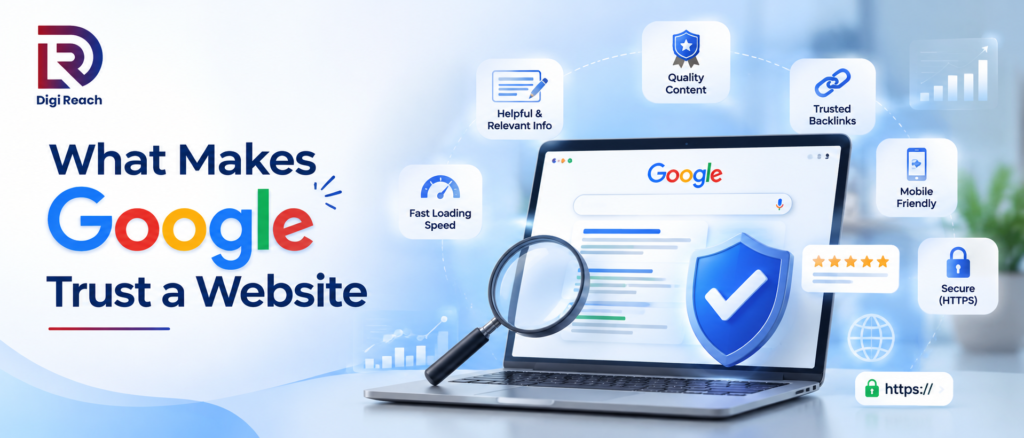
What Makes Google Trust a Website?
Getting a website to rank on Google is not just about adding keywords to your pages. Google wants to show users websites that provide helpful, reliable, accurate, and relevant information.
So, what makes Google trust a website?
Google looks at many signals to understand whether a website deserves visibility in search results. These include quality content, website experience, backlinks, technical SEO, security, authority, and signs of real expertise.
Building trust does not happen overnight. Instead, it comes from consistently following good SEO practices and giving users a reason to trust your business.
Let’s look at the key factors that can help build website trust.
- Helpful and High-Quality Content
Content is one of the most important parts of a trustworthy website.
Google wants content that genuinely helps people rather than content created only to attract search traffic.
Your website content should:
- Answer the user’s actual question
- Provide useful and accurate information
- Be easy to understand
- Match the search intent
- Avoid unnecessary repetition
- Provide original insights where possible
- Be regularly reviewed and updated when needed
For example, if someone searches for “how to improve local SEO,” a useful article should explain practical steps instead of simply repeating the phrase “local SEO” throughout the page.
Focus on helping the reader first. SEO should support the content, not replace its value.
- Demonstrating E-E-A-T
E-E-A-T stands for:
- Experience
- Expertise
- Authoritativeness
- Trustworthiness
These principles help Google assess the quality and reliability of content.
You can strengthen E-E-A-T by showing who created your content, highlighting relevant experience, using reliable information, and making your business details easy to verify.
For business websites, consider adding:
- Author information
- Company information
- Contact details
- About Us page
- Customer reviews
- Case studies
- Relevant credentials
- Reliable sources where appropriate
Trust becomes especially important for websites covering topics that can significantly affect people’s health, finances, safety, or well-being.
- A Strong Backlink Profile
Backlinks are links from other websites pointing to your website.
When reputable and relevant websites link to your content, they can help strengthen your website’s authority.
However, more backlinks do not automatically mean more trust.
A few relevant, high-quality backlinks can be more valuable than hundreds of low-quality links.
Good link-building opportunities can include:
- Industry publications
- Local business websites
- Relevant directories
- Partner websites
- Guest contributions
- Digital PR
- Useful resources that naturally attract links
Avoid building links through spammy or manipulative methods. Quality and relevance matter more than quantity.
- A Secure Website
Website security is another important part of creating a trustworthy online experience.
Your website should use HTTPS, which helps protect information exchanged between the user’s browser and your website.
A secure website can also create greater confidence among visitors, particularly when they need to submit contact information, make payments, or create an account.
Make sure your SSL certificate is correctly installed and your website does not display security warnings.
- Good Technical SEO
Even excellent content can struggle if Google cannot properly access, understand, or index your website.
Technical SEO helps search engines discover and process your pages.
Important areas include:
- XML sitemap
- Robots.txt
- Proper indexing
- Mobile-friendly design
- Fast page loading
- Clean URL structure
- Canonical tags
- Internal linking
- Structured data where relevant
- Fixing broken links
- Eliminating unnecessary technical issues
Regular technical SEO checks can help identify problems before they affect your search visibility.
- Positive User Experience
Google wants users to find useful results and have a good experience after visiting a website.
Your website should therefore be easy to navigate and use.
Pay attention to:
- Mobile responsiveness
- Page speed
- Clear navigation
- Readable fonts
- Logical page structure
- Useful internal links
- Easy-to-find contact information
- Clear calls to action
- Minimal intrusive elements
A visitor should be able to understand what your business offers without struggling to find important information.
- Consistent and Accurate Business Information
For local businesses, consistency matters.
Your business name, address, phone number, website details, and other important information should be accurate across your website and relevant online platforms.
A complete Google Business Profile can also help local businesses provide useful information to potential customers.
Make sure important details such as:
- Business name
- Address
- Phone number
- Opening hours
- Services
- Website URL
are kept accurate and updated.
- Real Reviews and Reputation Signals
Online reputation can influence how users perceive your business.
Genuine customer reviews can provide useful social proof and help potential customers feel more confident about choosing your business.
Encourage genuine customers to leave honest feedback after using your products or services.
However, don’t try to manufacture trust with fake reviews or misleading claims.
Real experiences build stronger long-term credibility than artificial reputation signals.
- Freshness and Ongoing Website Maintenance
Publishing content once and then forgetting about your website is not a strong long-term SEO strategy.
Some content needs regular updates because information, statistics, products, services, or industry practices can change.
Review your important pages periodically and update outdated information when necessary.
You should also check for:
- Broken links
- Outdated statistics
- Old service information
- Missing pages
- Technical errors
- Outdated images
- Poor-performing content
A maintained website gives visitors a better experience and helps keep your information accurate.
Does Google Trust Websites With More Content?
Not necessarily.
Publishing hundreds of articles does not automatically make Google trust your website.
Quality matters more than simply increasing the number of pages.
For example, 20 detailed articles that answer specific customer questions can be more useful than 200 short articles created mainly to target keywords.
Instead of asking:
“How many blogs should we publish?”
Ask:
“What useful information does our audience need?”
This approach can help you build a stronger content strategy.
How Long Does It Take for Google to Trust a Website?
There is no fixed timeline for Google to “trust” a website.
SEO is a gradual process. Results can depend on factors such as:
- Website age and history
- Competition
- Content quality
- Backlink profile
- Technical health
- Industry
- Search demand
- Website authority
- Consistency of SEO efforts
New websites may need time to establish authority and demonstrate that they consistently provide useful information.
Therefore, businesses should focus on sustainable SEO rather than expecting instant rankings.
Common Mistakes That Can Hurt Website Trust
Some SEO practices can make a website appear less reliable or provide a poor user experience.
Avoid:
- Keyword stuffing
- Duplicate content
- Fake reviews
- Low-quality backlinks
- Misleading titles
- Automatically generated pages with little value
- Hidden text
- Poor mobile experience
- Slow-loading pages
- Outdated business information
- Publishing content without checking accuracy
The goal should always be to build a website that users can confidently visit, understand, and use.
How DigiReach Can Help Build a More Trustworthy Website
Building website trust requires more than publishing blogs.
At DigiReach, we can help businesses develop a complete SEO strategy focused on content quality, technical SEO, on-page optimization, local visibility, authority building, and long-term growth.
From improving your website structure to creating helpful content and strengthening your online presence, every part of your SEO strategy should work toward the same goal: becoming a useful and trustworthy result for your target audience.
Conclusion
So, what makes Google trust a website?
There is no single ranking factor that creates trust. Instead, trust comes from a combination of helpful content, strong E-E-A-T signals, relevant backlinks, technical SEO, website security, positive user experience, accurate information, and consistent effort.
If you want sustainable search visibility, don’t focus only on ranking for keywords. Build a website that deserves to rank.
Follow up Instagram and Facebook for more up information.


