
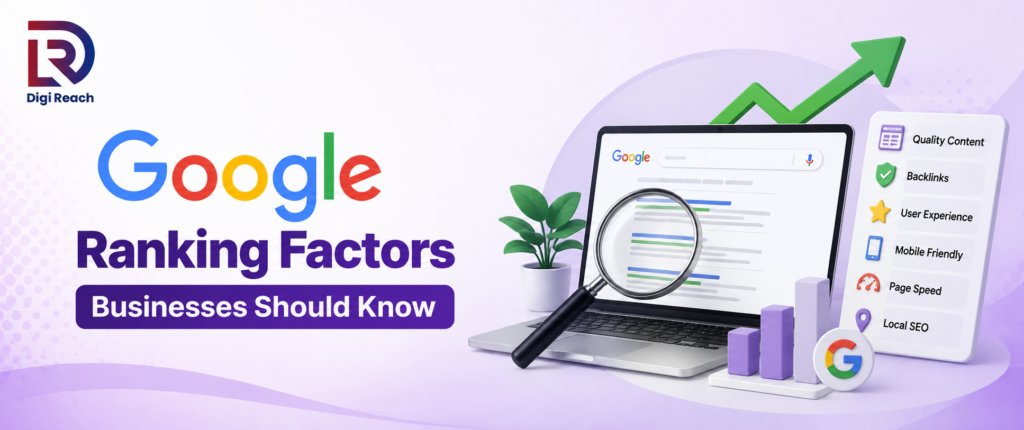
Google Ranking Factors Businesses Should Know
Introduction
Google ranking is important for businesses that want more website visitors, leads, and sales. However, getting a higher position on Google is not just about using keywords. Google looks at many different factors when deciding which pages should appear in search results.
For businesses, understanding Google ranking factors can help build a better SEO strategy and improve online visibility. Useful content, a good website experience, backlinks, technical SEO, and local relevance can all affect how well a website performs in Google search results.
What Are Google Ranking Factors?
Google ranking factors are the things Google looks at when deciding where a webpage should appear in search results. These factors help Google understand if a page is useful, relevant, trustworthy, and easy to use.
Google uses many different signals to rank websites, not just one factor. So, businesses should focus on a complete SEO strategy instead of trying to improve only one area.
1. High-Quality and Helpful Content
Content is one of the most important parts of SEO. Google aims to show content that is useful, accurate, and relevant to what users are searching for.
Businesses should create content that answers real customer questions and solves problems. Avoid writing content only to include keywords. Instead, focus on:
- Providing original and useful information
- Answering search intent clearly
- Covering topics in enough detail
- Using simple and readable language
- Keeping information accurate and updated
- Adding practical examples where useful
A good content strategy can help businesses become trusted in their industry and attract visitors at different stages of their buying journey.
2. Search Intent and Relevance
Understanding what people want when they search is important. A page may use the right keyword but still struggle to rank if it does not answer what users are looking for.
For example, someone searching for best digital marketing agency may be looking for a service provider, while someone searching for digital marketing tips may want useful information or advice.
Before creating a page, businesses should understand whether the search intent is:
- Informational
- Commercial
- Transactional
- Navigational
Creating content that matches the user’s purpose can improve relevance and engagement.
3. Website Experience
User experience is an important part of SEO. Visitors should be able to use your website easily and find the information they need without any difficulty.
A business website should have:
- Clear navigation
- Easy-to-read content
- Logical page structure
- Mobile-friendly design
- Fast loading pages
- Clear calls to action
- Minimal intrusive elements
A good website experience can also help visitors stay longer and take meaningful actions, such as submitting a form or contacting the business.
4. Mobile-Friendliness
Many people use smartphones to search for products, services, and businesses. Therefore, your website needs to work properly on mobile devices.
Check that text is readable, buttons are easy to tap, images display correctly, and important information is not hidden on smaller screens.
A mobile-friendly website provides a better experience for users and supports your overall SEO strategy.
5. Page Speed and Core Web Vitals
Website performance matters because slow pages can create a poor user experience. Google uses Core Web Vitals as part of its page experience signals.
Businesses should pay attention to areas such as:
- Loading performance
- Responsiveness to user interactions
- Visual stability
Compressing images, improving website code, reducing unnecessary scripts, and using reliable hosting can help improve performance.
6. Technical SEO
Technical SEO helps search engines crawl, understand, and index your website.
Important technical SEO elements include:
- XML sitemap
- Robots.txt
- HTTPS security
- Proper URL structure
- Canonical tags
- Internal linking
- Correct redirects
- Crawlability
- Indexability
- Structured data where appropriate
Technical problems can prevent valuable pages from being properly discovered or indexed. Regular technical SEO checks can help businesses identify and fix these issues.
7. Backlinks and Website Authority
Backlinks are links from other websites pointing to your website. Quality backlinks can help demonstrate credibility and authority.
However, businesses should focus on quality rather than quantity. A relevant, trustworthy website linking to your content can be more valuable than many low-quality links.
You can build backlinks through:
- Useful original content
- Digital PR
- Industry publications
- Guest contributions
- Business directories
- Local citations
- Partnerships and relevant resources
Avoid manipulative link-building practices that may put your website at risk.
8. Internal Linking
Internal links connect pages within your own website. They help users discover related information and help search engines understand the relationship between your pages.
For example, a digital marketing agency could link a blog about SEO strategy to its SEO service page.
Good internal linking can help:
- Improve website navigation
- Distribute page authority
- Help search engines discover pages
- Strengthen topic relationships
- Encourage visitors to explore more content
9. On-Page SEO
On-page SEO helps search engines understand the main topic of a webpage.
Businesses should optimise important elements such as:
- Page title
- Meta description
- H1 and other headings
- URL
- Main content
- Image alt text
- Internal links
- Relevant keywords
Keywords should be used naturally. Keyword stuffing can make content difficult to read and does not create a good user experience.
10. Local SEO Signals
For businesses serving specific locations, local SEO is especially important. Google considers local relevance when showing businesses for location-based searches.
Businesses should maintain accurate and consistent information across their online presence, including:
- Business name
- Address
- Phone number
- Business categories
- Service information
- Customer reviews
- Local website content
Creating location-specific service pages and useful local content can also help businesses become more relevant for local searches.
11. Trust and Credibility
Google aims to provide users with reliable information. Businesses should therefore demonstrate who they are, what they offer, and why customers should trust them.
Important trust signals can include:
- Clear About Us information
- Contact details
- Author information where relevant
- Customer reviews
- Testimonials
- Business credentials
- Accurate service information
- Secure website connections
For businesses operating in areas where incorrect information can have serious consequences, demonstrating expertise and trust is particularly important.
12. Fresh and Updated Content
Some topics change over time. Outdated content may no longer provide the best answer to users.
Businesses should regularly review important pages and update information when necessary. This may include updating statistics, services, prices, examples, links, or outdated recommendations.
However, content should not be changed simply to appear “fresh.” Updates should add genuine value for users.
13. Image and Media Optimisation
Images can improve the user experience, but large or poorly optimised files can slow down a website.
Businesses should use relevant images and optimise them by:
- Compressing file sizes
- Using suitable formats
- Adding descriptive alt text
- Using meaningful file names
- Avoiding unnecessary images
Videos, graphics, and other useful media can also make content more engaging when they genuinely support the topic.
How Can Businesses Improve Their Google Rankings?
There is no single shortcut to higher Google rankings. Businesses should take a complete approach to SEO.
Start by auditing your website and identifying technical issues. Then review your existing content, improve pages that do not fully satisfy search intent, strengthen internal linking, optimise important on-page elements, and build relevant authority.
For local businesses, also focus on local SEO and maintaining consistent business information across important platforms.
Most importantly, SEO should focus on users first. When your website provides useful information, a smooth experience, and clear answers, it becomes better positioned for long-term organic growth.
Conclusion
Understanding Google ranking factors can help businesses make smarter SEO decisions. Content quality, search intent, website experience, mobile usability, page speed, technical SEO, backlinks, internal linking, on-page optimisation, and local relevance can all contribute to stronger search visibility.
SEO is a long-term process, not a one-time task. By consistently improving your website and creating genuinely useful content, your business can build greater visibility, credibility, and opportunities from organic search.
Follow up Instagram and Facebook for more information.
FAQs
What is the most important Google ranking factor?
There is no single factor that guarantees higher rankings. Google considers many signals, including relevance, helpful content, page experience, technical accessibility, and authority.
Do keywords still matter for Google rankings?
Yes. Keywords can help Google understand the topic of a page. However, businesses should use keywords naturally and focus on satisfying search intent rather than keyword stuffing.
How long does it take to improve Google rankings?
SEO results vary depending on competition, website condition, content quality, authority, and the strategy used. Consistent SEO improvements generally produce better long-term results than short-term tactics.
Are backlinks still important for SEO?
Relevant and trustworthy backlinks can contribute to website authority. Businesses should prioritise high-quality, relevant links instead of trying to gain large numbers of low-quality links.
How can a small business improve Google rankings?
Small businesses can focus on helpful content, local SEO, technical website health, mobile usability, on-page optimisation, internal linking, customer reviews, and earning relevant backlinks.


